Porsche is approaching one of the most important turning points in its modern history. After betting heavily on electrification, the company is now recalibrating its strategy around a much more pragmatic idea: the future of Porsche will not be purely electric, purely petrol, or purely digital. It will be about building the cars customers actually want to buy.
That shift comes at a critical moment. Porsche delivered 122,306 vehicles globally in the first half of 2026, down 16% year on year. China was particularly difficult, with deliveries falling 32%, while the 911 went in the opposite direction, rising 19%.
And that may be the biggest clue to Porsche’s future.
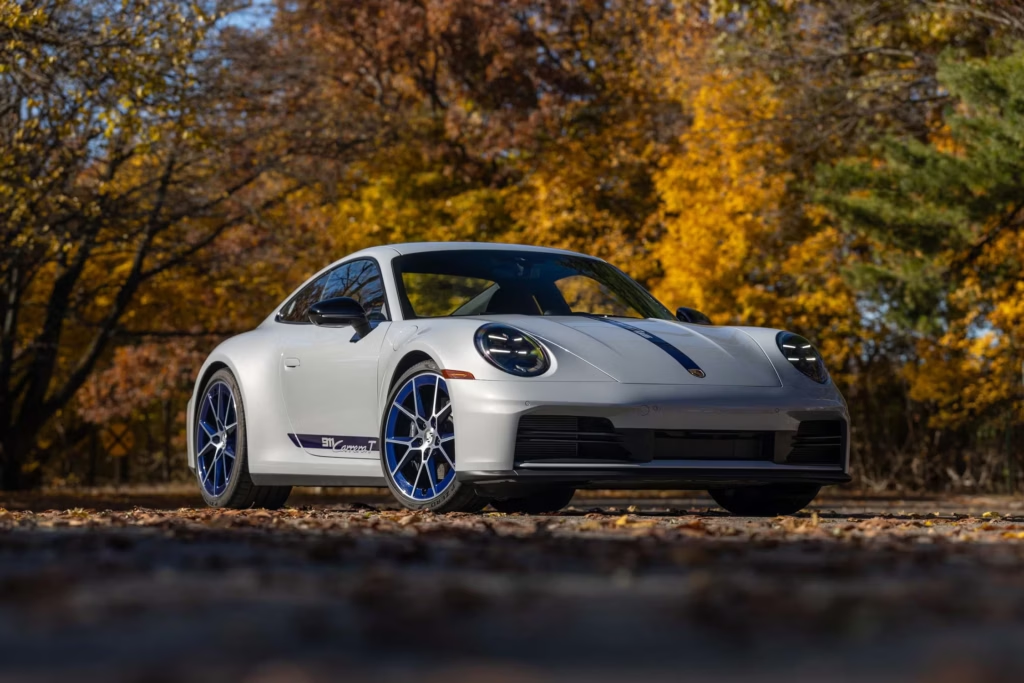
Porsche’s EV gamble has not gone to plan
Porsche was one of the premium manufacturers that appeared particularly well positioned for the electric transition. The Taycan demonstrated that an electric sports car could still feel like a Porsche, while the electric Macan brought the technology into Porsche’s most important volume segment.
But customer demand has not developed as Porsche expected.
The company now openly acknowledges that its expectations for the speed of the electric transition did not materialise. Its new Strategy 2035 therefore calls for a flexible portfolio covering internal-combustion engines, plug-in hybrids and battery-electric vehicles.
This is not Porsche abandoning EVs.
It is Porsche abandoning the idea that one technology should dictate the entire future of the brand.
The 911 is the blueprint
The most revealing decision may be the simplest one: there will not be a fully electric 911.
Porsche CEO Michael Leiters has confirmed that the iconic sports car will remain outside the company’s full-BEV strategy.
That makes enormous strategic sense.
The 911 is not simply another vehicle. It is Porsche’s emotional centre. It represents the sound, engineering, balance, mechanical involvement and heritage that differentiate Porsche from a technology company producing luxury electric vehicles.
The 911 has also demonstrated remarkable demand. Porsche delivered 30,534 examples during the first half of 2026, an increase of 19%.
The lesson is important: Porsche’s greatest asset isn’t its battery technology. It is desire.
Expect Porsche to become hybrid-first in the middle
The most interesting part of Porsche’s future is likely to be the space between petrol and fully electric.
Plug-in hybrids offer Porsche a way to combine performance, emissions compliance and everyday usability without asking customers to give up the character of the brand.
That could mean increasingly sophisticated hybrid versions of the 911, Cayenne, Panamera and other performance models, while EVs occupy the segments where customers genuinely want them.
Porsche has already demonstrated this approach with hybridisation of the 911 and other models.
The result could be a much more interesting product strategy:
Petrol for emotion.
Hybrid for performance and flexibility.
Electric for instant performance and urban luxury.
Rather than forcing customers into one technology, Porsche can sell all three.
The Macan could become Porsche’s biggest strategic test
The Macan is particularly important because it sits at the intersection of Porsche’s growth ambitions and the reality of customer demand.
Porsche is planning a new petrol Macan for around 2028, according to recent reporting, while continuing with the electric Macan.
That is a significant change in direction.
Instead of saying, “The future is electric, therefore you must buy an electric Porsche,” the company is effectively saying:
“Here are two Porsches. Choose the one that suits you.”
That could actually strengthen the brand.
China is the biggest problem
Porsche’s China problem cannot simply be solved by bringing back combustion engines.
Deliveries in China fell 32% during the first half of 2026. At the same time, Chinese manufacturers such as BYD and Xiaomi are becoming increasingly sophisticated in electric vehicles, software, pricing and speed of product development.
This creates a very different competitive environment.
Porsche is no longer simply competing against Ferrari, Lamborghini, Mercedes-AMG and BMW.
It is increasingly competing against technology-led Chinese manufacturers that can develop products faster and at lower cost.
Porsche’s answer appears to be value over volume rather than chasing every possible customer. Its Strategy 2035 specifically emphasises preserving brand exclusivity while adapting its Chinese offering to local market requirements.
That may ultimately be the correct strategy.
Porsche should not try to become Germany’s answer to BYD.
It should remain Porsche.
Porsche is also being forced to become smaller
The financial reality is brutal.
Volkswagen took a €6 billion writedown on its 75% stake in Porsche in September, following another €2.7 billion impairment the previous year. Reuters has reported that Porsche’s profitability and position within Volkswagen have deteriorated substantially.
Job reductions are therefore part of the restructuring, with reports suggesting thousands more positions could ultimately be affected.
Porsche’s response is essentially to reduce complexity, lower its break-even point, streamline development and concentrate investment on its strongest products. Its official Strategy 2035 explicitly targets a leaner organisation and lower break-even point.
And this could actually be good for Porsche.
For years, the luxury automotive industry has been obsessed with volume.
But Porsche doesn’t need to become Toyota.
It needs to make fewer cars that more people desperately want.
The future Porsche should be about scarcity
This is where Porsche could potentially rediscover its greatest competitive advantage.
The brand sits in a fascinating position between premium and luxury. It has the ability to create derivatives, special editions, GT cars, Turbo models and highly personalised vehicles that command enormous margins.
Porsche’s own strategy increasingly talks about individualisation, Exclusive Manufaktur and positioning the company between Sport Luxury and Sport Premium.
That suggests the Porsche of the 2030s could be less about chasing market share and more about increasing the value of every customer.
Imagine a Porsche business where:
- The 911 remains the emotional flagship.
- Hybridisation becomes the performance bridge.
- EVs dominate where they make genuine customer sense.
- The Macan and Cayenne generate volume without diluting exclusivity.
- Special editions become increasingly desirable.
- Personalisation becomes a major profit centre.
- Software enhances the driving experience rather than replacing it.
- AI reduces development and operating costs behind the scenes.
- Production becomes more flexible.
- China becomes a selective premium market rather than a volume obsession.
That is a much more compelling future.
Porsche’s next chapter is not about petrol versus electric
The real question is whether Porsche can convince customers that technology serves the sports car, rather than the sports car serving technology.
That distinction matters.
The Taycan proved Porsche could build an extraordinary electric car. But extraordinary technology alone does not guarantee extraordinary demand.
The 911 demonstrates the opposite.
Customers don’t buy it because it has the latest technology.
They buy it because they want a 911.
That is Porsche’s moat.
And as the company prepares to reveal more of its Strategy 2035 at its Capital Markets Day on October 7, 2026, the world will be watching to see whether Porsche can turn that lesson into a sustainable business model.
The Porsche of 2035
My prediction is that the Porsche of 2035 will be considerably more diverse than the Porsche many people expected five years ago.
There will be electric Porsches.
There will be hybrid Porsches.
There will still be combustion-engine Porsches.
And, most importantly, there will still be Porsches that make people turn around and look at them.
Because Porsche’s future isn’t ultimately about the fuel in the tank or the size of the battery.
It is about desire.
And if Porsche gets that right, its biggest comeback may not come from building more cars.
It may come from remembering why people wanted a Porsche in the first place.